
La Calisto
Women (and nymphs) beware women, and men, and deities, and ...

Again, in default of possessing a cognitive winnowing fan, flummoxed for a thematic hill among the myriads on offer on which to die for this cross-quarter communiqué, I some few days ago interrogated a person whose judgement I most confidently esteem as to what that one would deem a worthy topic to which I might usefully address myself, and was answered by her in this wise (and I condense, a little, paraphrastically): Rape culture. The “rape academy”. Gisèle Pelicot. Rape. Women are furious. Rape. Rape. Rape. Write about that.
Prior to but roughly contiguously temporally with receiving this warrantedly-hortatory commission, I was ambushed by a silent notification on my phone, the which betrayed YouTube’s having got a gander (altogether technically legally, of course — I did blithely accept those terms of use sometime back in the teens of the century) at an Amazon wish list still extant, though I’ve made no resort to it for years, on the wicked Lord Bezos’s site; within the said roster of what consisted almost exclusively of desirable AV items was a DVD of a production of Francesco Cavalli’s 1651 opera La Calisto — and so refined are the (suspected) surveillance tools now that I was solicited to make contact not with the relatively superannuated original exemplar (most likely it’s no longer on offer; I’m certainly not going cyberspelunking for it, lest I rouse the digital Cerberi) but to a soon-to-drop Harmonia Mundi CD of the work by Ensemble Correspondances under the direction of Sébastien Daucé. Hyperobnoxious and extremely impertinent ad intrusions have slowed my progress in getting through it (I stalled out at the end of a increasingly discontinuous audition of Act 1 and have yet to resume), but, fuck me, it’s free, and I’m enjoying the performances (and the weirdly big array of instrumentalists — nearly sixfold above what the composer put in the pit at the premiere), so I will persist. And, well, what a coincidence: my attention directed to something baroque and Ovid-adjacent that turns on … rape. About which it is strongly suggested I write something. Very well; I guess I start here.
Or, rather, start here again: I have form for ruminating on rapine in its specifically classicizing mode, having extendedly treated of it back at The Old Place™ half a decade ago, when in the train of searching in 2021 for emblem-lit content I’d not hitherto deployed in my annual encomia to sprung spring I, glumly but without disappointment (I by then, disabused of any fancies of possible sectorial pristinities, pricing XY-human depravity in to any anatomy of an antiquity-descended ideate armature), flopped into a lurid bog of males going matter-of-factly about the business of the sexual violation of females. To begin, I will to the end of abbreviating Callisto’s singularly lamentable narrative through weaving a rete of stipulation incorporate here (lightly edited) the greater part of the said essay.

[20.iii.21]
… I purposed originally, upon pitching on Flora as my iconographic focus, to fetch an image out of Vicenzo Cartari, and discovered that the only portrayal of her in any of the editions at my disposal placed her amid a facially-placid party scene with the four winds and the daughter of Erechtheus. Informed by the Italian gloss for the illustration that the goddess was espoused to Zephyrus, and Oreithyia to Boreas, but given nothing beyond that, I went on the hunt for framing. And, not greatly surprised, found rape.
It’s hard not to drift into the topos of rape when trawling in the broad, shallow seas of Hellenistic literature, but a distinct, repulsively gleeful crudity attaches in the specifically Italic narratives. For example, I was a couple of weeks ago rummaging around in the Romulus mythos and found that Mars begot the founder by raping a Rhea Silvia rendered insensible by a roofie slipped her at the war-god’s instance by Somnus. (One may see this numinally-effected and thus not so much casually as blithely criminal episode plastically realized, in a manner insanely crowded and brain-freezingly overripe, on the front panel of an early 3rd-c.-CE sarcophagus in Rome’s Palazzo Mattei; it very much repays inspection.) I certainly wasn’t seeking out tales of violated women in the perireligious fabulism of the Romans, but one fell out of my research all unbidden anyway, and had I been probing elsewhere in the general topic-area, I doubt not that I’d have in short order stumbled across another, rape in slavery-buttressed martial patriarchies being self-evidently a feature, not a bug.
So Ovid, at 5.201 of Metamorphoseon, first in the Latin and then in Frazier’s prose rendering:
Ver erat, errabam: Zephyrus conspexit, abibam.
Insequitur, fugio: fortior ille fuit,
et dederat fratri Boreas ius omne rapinæ
ausus Erechthea præmia ferre domo.
Vim tamen emendat dando mihi nomina nuptæ,
inque meo non est ulla querella toro.
Vere fruor semper: semper nitidissimus annus,
arbor habet frondes, pabula semper humus.
(“’Twas spring, and I was roaming; Zephyr caught sight of me; I retired; he pursued and I fled; but he was the stronger, and Boreas had given his brother full right of rape by daring to carry off the prize from the house of Erechtheus. However, he made amends for his violence by giving me the name of bride, and in my marriage-bed I have naught to complain of. I enjoy perpetual spring; most buxom is the year ever; ever the tree is clothed with leaves, the ground with pasture.”)
All very jolly. Flora suggests she was a little put out, but promotion by way of the violation from the status of a mere nymph to that of a deity (howbeit a minor one) smoothed over whatever hard feelings the business of the inaugural outrage occasioned, and all’s well that ends well. Did women of the era conceive this to be a satisfactory state of affairs? Any women? Class analysis surely plays a role in that: a matron of a notable gens might wink at the frivolous poem and the antics of its personified abstractions, but would almost assuredly furiously discountenance anything of the sort in objective reality — visited on peers in her social stratum, that is. A scullery drab at a lanista’s compound, or, indeed, any of her own servile housemaids? That would be a different matter (provided, of course, that her property wasn’t roughed up into inutility in the assault). Maybe a sex worker in the stews of Pompeii, the facts on the ground of the circumambient culture and of her particular circumstances presenting as brutally immutable, might think of a sublunary analogue of Flora’s career as a pretty good deal. In any event, what the uncountable generations of flesh-and-blood Roman women living between the poles of aristocracy and slavery may have made of their context of enforced victimhood is axiomatically unmarked in the unrelievedly masculine literary milieu of the antique. …


Callisto the Oread huntress in Diana’s retinue is of all the humans and minor divinities raped by Jupiter perhaps the most melancholy-inducingly pitiable instance, she cozened by the All-Father’s personation of her mistress and, d’après Ovid, discovering too late that the solicitude of feigned Cynthia was but feigning Jove’s imposture. The lord of Olympus did in this sense approximate a being of the sort the Rowlingoid TERFs conceive when they construct the typus of the predatory faux transwoman haunting the ladies’ rooms of Terra in their turbulently deluded consciousnesses, which is effectively the only locus apart from the lines of Publius Ovidius Naso occupied by the construction.
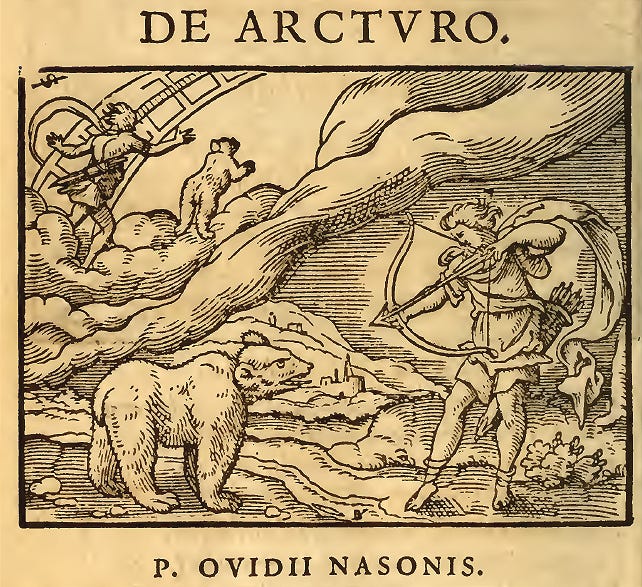
The Jovian delict outstrips in callous violence even the subsequent cruelties of Diana — who expels the nymph, discovered to be gravid and so ipso facto no longer possessed of the virginity Apollo’s sister demands, from the band — and Juno — Saturnia takes her revenge by destroying her spouse’s victim’s primate beauty (and, collaterally, qualifying Callisto for inclusion in the son of Sulmo’s poem of radical and mostly ruinous change), immuring her rational mind in an ursine shell; but the collusion of women in the degradation of other women hits strongly signifyingly in an age of the republic that sees MAGA XXs irrationally, against any cognizable real-world interest, exalting the chimeric tradwife or seconding the repeal of the Nineteenth Amendment. And as with Flora’s violation, no harm done, at least as far as a Jupiter pleased to imagine he works restorative justice is concerned — you and our son Arcas, who was all unknowing fixing to put a javelin into you his mom [all the Renaissance and Baroque representations show him drawing down on her un-Ovidianly with a bow — symmetry with Diana?], you’re both undying fires now (or something; what are “stars”? well, never mind), immortal, isn’t that great? Isn’t it?
Whenever comes to mind a clip I saw in which the posh-purulent thing that is Boris Johnson let rip in his Eton Greek with a lengthy swath of Homer — for no particular reason that I can recall, except, certes, to advertise that he was the public-schooliest of public-school boys — I am minded as to why rape culture is alive and well among the men fascinated with the Romans conceived as positive role-models. And disheartened by the brute facticity of it. Yet on we go, half of humanity with boots/caligæ, implicitly at minimum, on the necks of the other half. The pulverizing horror of it all will not stand forever, but how it falls without the aftermath looking like a family-annihilator scenario I, unhappily, cannot picture. Cybele help us.
[Illustration from Reusner’s Picta Poesis Ovidiana (Frankfurt, 1580).]
Beltane Yijing ’26: A Nice Lunch and Then the Afternoon Session in Council
Maybe? Make of of it what you can/will. Canon Legge’s translation, as ever, stringently woke-ified by your humble scribbler.
In Statu Quo

Yi/Corners of the Mouth
indicates that with firm correctness there will be good fortune. We must look at what we are seeking to nourish, and by the exercise of our thoughts seek for the proper aliment.
The unitary first: You leave your efficacious tortoise, and look at me till your lower jaw hangs down. There will be evil.
The bipartite second shows one looking downwards for nourishment, which is contrary to what is proper; or seeking it from the height, advance towards which will lead to evil.
The bipartite third shows one acting contrary to the method of nourishing. However firm that one may be, there will be evil. For ten years action will not in any way be advantageous — let that one take none
The bipartite fourth shows one looking downwards for to nourish. There will be good fortune. Looking with a tiger’s downward unwavering glare, and with the desire that impels it to spring after spring, that one will fall into no error.
The bipartite fifth shows one acting contrary to what is regular and proper; but if that one abide in firmness, there will be good fortune. That one should not cross the great stream.
The unitary sixth shows the one from whom comes the nourishing. That one’s position is perilous, but there will be good fortune. It will be advantageous to cross the great stream.
Mutatio

Guan/View
shows the worshipper who has washed hands, but not presented offerings, with sincerity and an appearance of dignity.
The bipartite first shows the looking of a child; not blameable in subordinates, but matter for regret in those to whom they answer.
The bipartite second shows one peeping out from a door. It would be advantageous if it were the firm correctness of a passive nature.
The bipartite third shows one looking at that one’s own life; to advance or recede?
The bipartite fourth shows one contemplating the glory of the polity. It will be advantageous for that one, being such as that one is, to be a guest of the head of state.
The subject of the unitary fifth is shown contemplating that one’s own life. A person of elevated character, that one will fall into no error.
The subject of the unitary sixth is shown contemplating that one’s proper character to see if it be indeed that of a person of elevated nature. That one will not fall into error.